
Thai massage helps relieve stress from the body, combining pressure, stretching and conscious movements to release tension, calm the mind and restore a deep sense of balance.
There are times when the body speaks before the mind. It does so with a persistent tension in the shoulders, with a clenched jaw, with a stiff back or with that feeling of deep fatigue that does not go away even if the hours go by.
Stress does not always manifest itself as an obvious worry. Sometimes it settles in silently, accumulating in the musculature, altering breathing and gradually reducing the feeling of well-being. At that point, resting is not always enough. The body needs to let go.
Thai massage is one of the most complete therapies to relieve stress and release accumulated tensions. Through pressure, stretching and rhythmic movements, this ancient practice helps relax the body, calm the nervous system and restore a sense of deep balance.
Why stress accumulates in the body
When a person goes through a stressful time, the body activates its state of alertness. Breathing becomes shallower, muscles contract and the nervous system remains ready to respond to a threat, even if that threat is simply a full agenda, constant worry or emotional overload.
Over time, this sustained activation generates muscle tension. The areas most affected are usually the neck, shoulders, back, lower back and legs. The body begins to lose mobility, posture becomes more rigid and the mind finds it more difficult to switch off.
Thai massage acts precisely on this cycle: it helps to release physical tension so that the nervous system can gradually enter a state of rest and recovery.

How Thai massage helps relieve stress
Thai massage to relieve stress works in a deep but progressive way. It is not about forcing the body, but accompanying it towards an active relaxation, where the musculature is released and the mind finds a space to stop.
Pressures that release accumulated tension
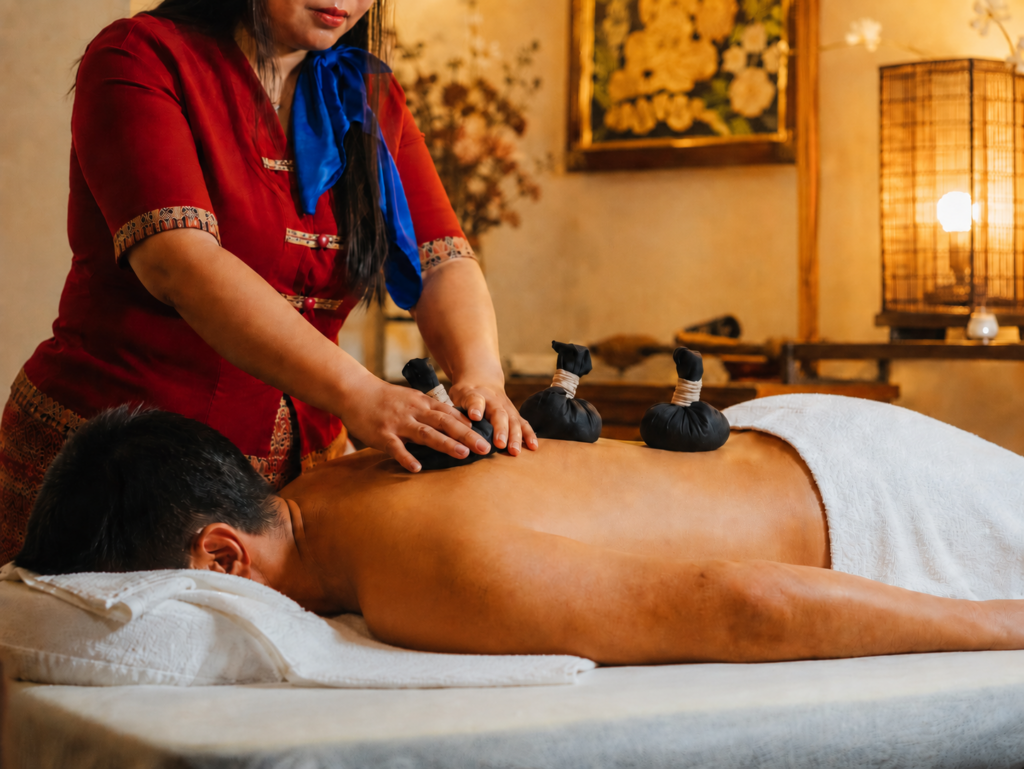
One of the bases of Thai massage is pressure on specific points of the body. These pressures help to relax areas of tension, activate circulation and reduce the feeling of stiffness.
The therapist works on areas where stress usually accumulates: trapezius, back, cervical, lower back, legs and feet. The pressure can be firm, but should always be adapted to the sensitivity of each person.
This way of working allows the body to let go little by little. Where there was contraction, space appears. Where there was rigidity, a sensation of lightness begins to emerge.
Stretches that restore amplitude to the body
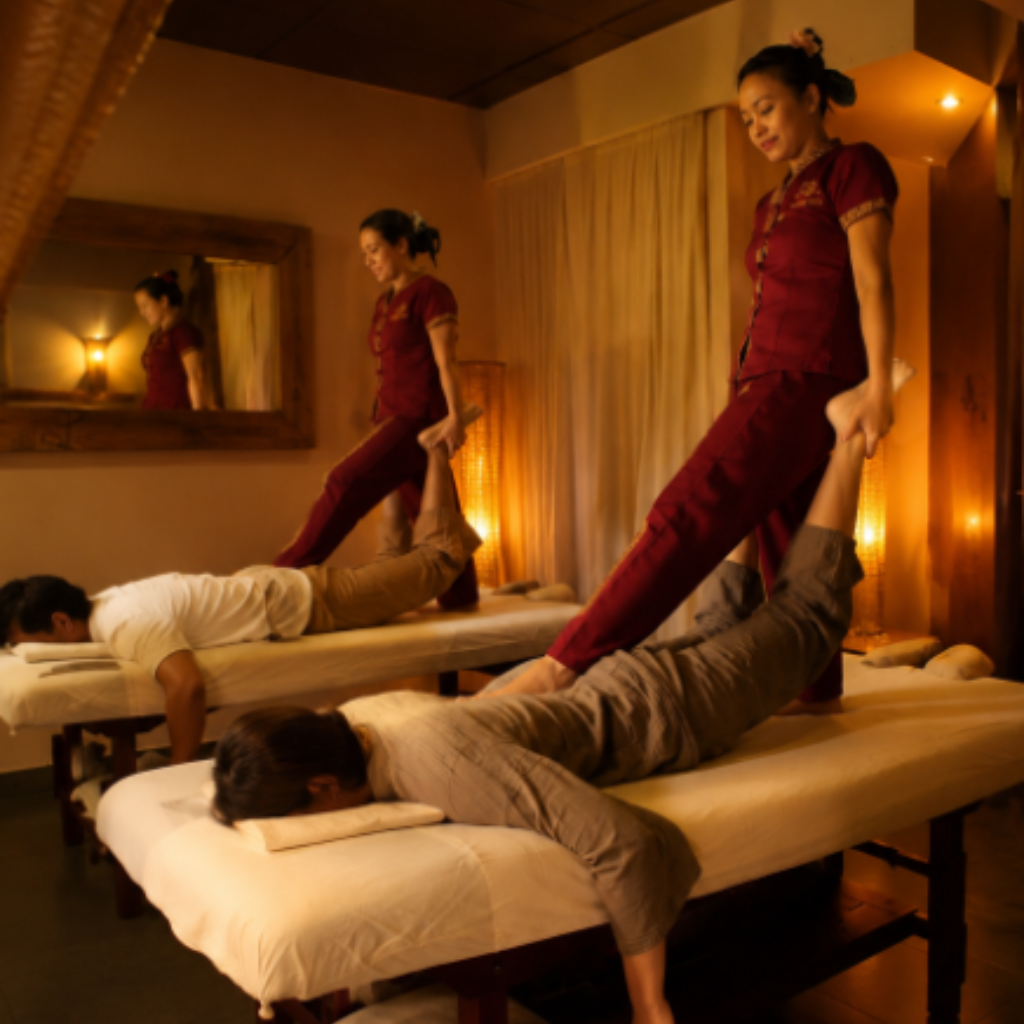
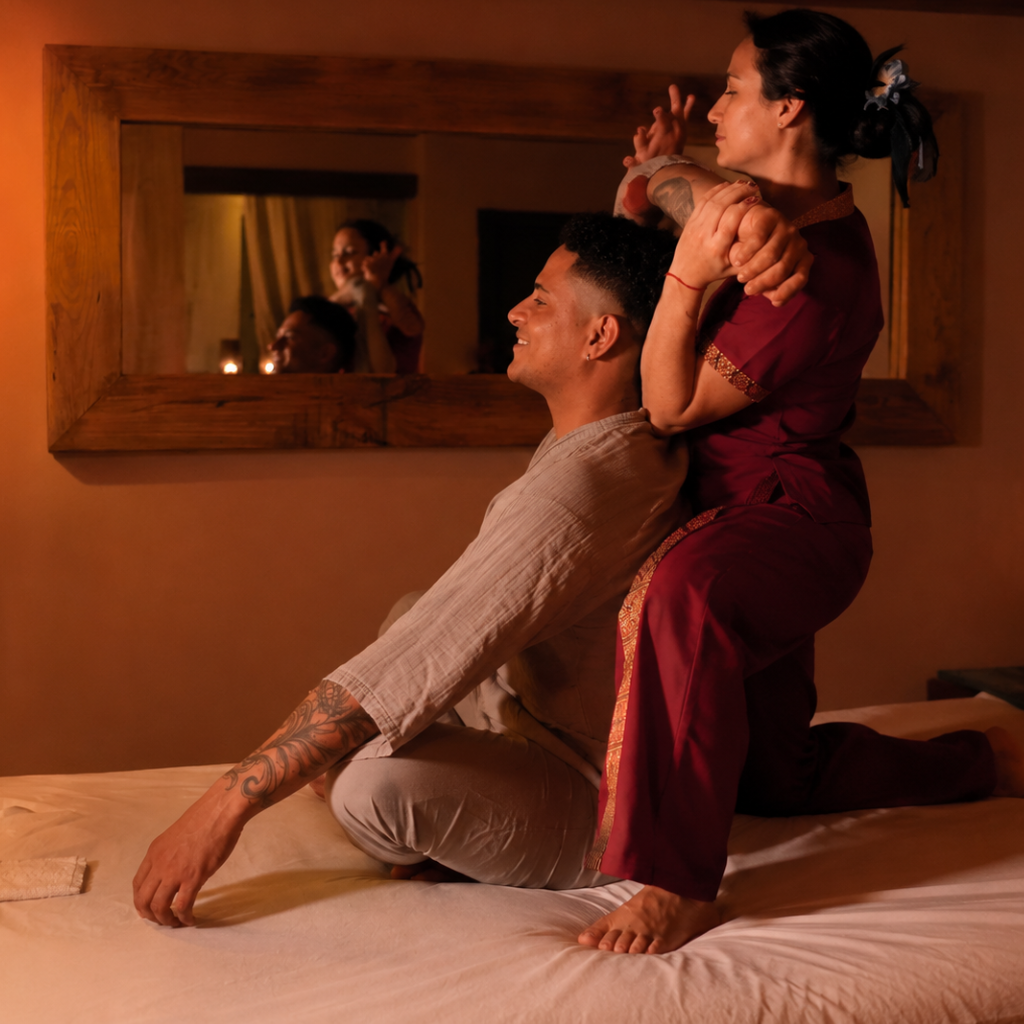
Thai massage is also known as a kind of “passive yoga”. During the session, the therapist guides the body through gentle, controlled stretches that help improve flexibility, release joints and expand range of motion.
These stretches are especially beneficial for people who spend many hours sitting, work in front of screens or feel the body blocked by the daily routine.
The sensation after the session is usually very characteristic: the body feels more open, more flexible and less heavy.
Slow rhythm to calm the nervous system
Stress is not only released by working the muscles. It is also necessary to send a safety signal to the nervous system.
The rhythm of Thai massage, its pauses, its sustained pressure and the attention of the therapist create an experience that invites the body to lower its guard. Breathing becomes deeper, the mind slows down and a calmness appears that is not superficial, but bodily.
It is a relaxation that is not only thought: it is felt.
Benefits of Thai massage for body and mind
The benefits of Thai massage go beyond the immediate feeling of relaxation. By working on muscles, joints, circulation and the nervous system, this therapy can help you regain a more complete well-being.
Among its main benefits are the following:
- Helps reduce physical and mental stress.
- Releases accumulated tension in the back, neck and shoulders.
- Improves mobility and flexibility.
- It favors a deeper and more conscious breathing.
- Activates blood and energy circulation.
- Reduces the sensation of body stiffness.
- Provides lightness and general well-being.
- It helps to disconnect from the hectic pace of everyday life.
- It favors a greater connection with one’s own body.
- It can contribute to improve the quality of rest.
Thai massage is not just about relieving a one-time discomfort. Its value lies in the way it helps the body remember a more natural state: less contracted, less rushed, more present.
Difference between relaxing Thai massage and traditional Thai massage
Although they share the same root, there are different ways to adapt Thai massage according to the needs of each person.
Traditional Thai massage tends to be more dynamic, with extensive stretching, intense pressure and deep mobilization. It is ideal for those seeking to release stiffness, improve mobility and work the body as a whole.
Relaxing Thai massage, on the other hand, can adapt the intensity to prioritize calmness, breathing and the feeling of rest. It maintains the characteristic pressures and stretching, but with a softer and more enveloping rhythm.
Both options can help relieve stress. The choice will depend on physical condition, sensitivity and the type of experience sought.
What does a Thai massage session feel like?
A Thai massage session can feel like a progressive journey from tension to openness. At first, the body may appear stiff or resistant, especially if you arrive with a lot of accumulated stress. But as the session progresses, the musculature begins to give way.
The pressures generate a feeling of deep release. Stretches provide amplitude. Pauses allow the body to integrate each movement. Gradually, the breath changes and the mind begins to accompany this calming process.
At the end, many people describe a mixture of relaxation and renewed energy. It is not a feeling of heavy sleep, but of lightness, as if the body has regained inner space.
Conclusion
Thai massage to relieve stress is much more than a body technique. It is an invitation to let go of accumulated weight, regain lost mobility and restore a sense of deep calm to the body.
Through conscious pressures, stretches and movements, this ancient therapy helps to release physical tensions and relax the mind from the body. It does not promise to stop the outside world, but it does offer something equally valuable: a space where the body can stop resisting and begin to rest.
In a life marked by haste, Thai massage reminds us of something essential: to take care of oneself is not to stop completely, but to learn to return to balance.
Book a Consultation
It’s easy and free!
Tags:Hair Spa